Showing posts with label writing. Show all posts

Monday, May 18, 2015

Great Marketing Tips


  • Blog, writing helpful and useful material. When you post them on Facebook groups, add a copyright notice at the bottom with a back link. If you write your posts like magazine articles, you can also submit them to print magazines and ezines (digital magazines).
  • Get published in ezines (online magazines) and magazines. Search Google for “ezine” or “magazine” and the subject of your books. You could also go to your local bookstore and browse through the magazine racks, writing down the names of magazines that may publish your type of articles. Then look up their websites online and submit your articles to them.
  • Get booked on radio shows. Do a google search for the keywords “radio show” and whatever subject your book is about. You can also join Radio Guide List. It’s free, and they’ll automatically email you lists of radio shows that need guests.
  • Do author joint venture launches for your books and participate in other authors’ ones. When you do your own book launch, ask each author for a free gift to those who purchase your book – usually a copy of their own book. Include a link to each author’s free gift on your book launch page that will take your customers to the other authors’ websites. To get a general idea of how to structure an online joint venture book launch, you can visit Trish’ book launch page.
  • Guest blogging – Submit your blog articles to other authors’ blogs. They always include back links to your blog/website, and often give you an opportunity to mention your work.
  • Host other authors’ guest posts. When you do, post links on your Facebook page and on the walls of the Facebook groups that you are a member of, with the same copyright notice and back links mentioned above. This will allow you to both drive traffic to your blog, and help other authors.
  • Connect with the right kind of followers: you can visit the websites of other authors who write books in your genre and find the link to their Twitter page. Once there, you can browse through the list of all of their followers. Follow people who are book readers (I avoid marketers, and steer clear of those who promise to increase your followers) and people who enjoy your genre. This will prompt them to follow you back, or at least check you out. Make sure your Twitter profile includes a link to your blog/website and a brief description of the kinds of books that you write. An added bonus is that books of authors in the same genre as you will be linked to your books on Amazon, if enough of your common followers also buy your books. So, every time they do a promotional event and sell a bunch of books, your books will also get exposed to a bunch of new customers.
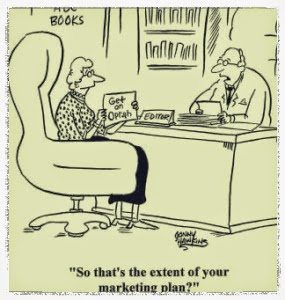
    Sounds like it might work... 
     Photo credit
  • Join a book club. You all know my experience with the Rave Reviews Book Club. It has increased my visibility and my sales, while generating a lot of new reviews.

  • Take part in a convention or organize a library event (eg a book signing, if you can get it). These tend to show up in local papers and newsletters, which have an on-line component.  Mandy expanded on this, by pointing out that local events and bookstores have been more successful for her book sales than online sales. She takes great care in exhibiting each book to its best advantage with themed displays, bookmarks, pre-order forms, competition details and entry forms. She also (rightly) advises against spamming out ‘buy my book’, which just turns people off, although you do need to be involved and interact with other authors and as well as readers. In her case, what worked was using her personal network and taking it from from there.
This information came from a conversation on the best book marketing strategies on LinkedIn. Authors Trish LeSage and Simon Denman, among others, shared some valuable insight.
Read more about Nicholas Rossis here.


Saturday, May 16, 2015

The Hardest Thing I've Had to Learn About Publishing

One thing I did not expect to learn about when I decided to publish my book is how much, desperately, I would HAVE have to learn PATIENCE.
Rome wasn't built in a day.

Here is a list of things you have to be patient about:
1. Getting through your first draft:
When you have ideas in your head, and maybe they're all jumbled up or maybe they're in a specific and planned order, you want to get them down quickly or you feel like they'll blow away in the wind.  But it takes time, and sometimes it does blow away with the wind and you stare at your computer screen with major writers block.  And sometimes you have to watch the kids or clean the house or, you know, shower.

2.  Your first draft will never be good enough:
When you finish the last sentence of the first draft you can't help but think, "Brilliant!  Georgous!  I just wrote the best book that's ever been written."  Believe me, you haven't.  What you think you've written is not what's actually on paper and you must revise revise revise.  Don't even bother sending it to anyone, not even your mother.  Edit it first and then send it to your beta readers.

3.  You have to figure out how to portray with words the story that is in your head:
Have you ever read a book that is a decent book but needs just a bit more editing?  I have.  In fact, recently I read a book where the whole plot of the book is about a boy and a girl who, after years of desire, finally decide to get married.  And then, suddenly the guy does something bad and now she can't trust him and they don't get married.  And the last chapter is about her getting married to this guy's best friend.  What?!  So why wasn't the book about their story?
One thing I have to work really hard on is writing.  Haha, I know that sounds funny, but listen, I am a good storyteller.  I've got great stories in my head.  But actually using words instead of ideas is a different thing altogether.  So you may think you've written a good story, but really you have to have other people's opinions to find out if you've been able to put down on paper what's really going on in your head.

4.  As soon as you hit 'Publish', hoards of people will not rush out to buy your book.  No matter how many friends and family you have:
Unfortunately, just because it's easier these days to publish, doesn't mean that people will buy your book.   I remember reading a great article by Brandon Sanderson.  He'd written 8 books and sent queries out and, after no word from agents, was feeling very discouraged.  But he pushed through his discouragement and started writing the next one.  And, finally!, an agent called him about his manuscript and wanted to buy it immediately--a whole year after he sent out his manuscript.
I'm so grateful that I didn't have to wait so long to publish TRISTEN.  However, even though you don't have to wait forever to get noticed by an agent (if you're self published), you still have to pay your dues getting noticed by readers.

5.  Amazon is like the popular girl at school who doesn't even know your name.  Yet:
This was one thing I wasn't sure about when I started writing.  I thought that Amazon would help market my book.  And only when when a sweet friend and author opened up about her experience did I realize that they don't really.  I decided to publish anyway.  I must be a masochist.

6.  Marketing is pretty much pointless until you have a few books out (unless you write nonfiction):
I've got some great ideas in mind for marketing, and would love to attend some conferences, but I think it's kindof silly to pay money to market 1 book, when I can pay the same amount of money to market 3 books.

7.  You have to publish your books in order:
Ever since I wrote the first book in the TRISTEN series, Book 4 has been screaming at me to write it.  But dang it, I have to write the others first cuz I'm not sure what exactly is going to happen before then.  And now that I'm done with the second one, the third one is jumping up and down, "My turn!" it screams.  But, once again, I'm in the middle of writing Book 2 and 1/2, which is a novella and is important to have a preface (in my mind) of Book 3.  So even though I've got major plot points and action scenes just dying to come out, I MUST WAIT.

So if you think that you're going to spit out a book and become an instant success, there is a small possibility that you just may.  However, don't get discouraged if you don't.  What percentage of authors attain that kind of success that quickly?  I can really only think of one or two.  And yet, there are so many out there who are successful, so don't give up, keep writing, and just BE PATIENT.

My name is Fleur.  And this is my blog.

When Science Meets Book Marketing

I love it when science meets book marketing!  If you wonder what I’m talking about, just read on.
I am an avid Economist reader.  Every issue has a small section about Science and Technology which, I have to confess, I prefer to Finances or Economics, as it invariably includes fascinating news.  In the latest issue, it mentions an experiment conducted by the State University of New York to see whether success breeds success.  The results are impressive and – I believe – are applicable to book marketing.
In this experiment, a team wanted to examine whether giving people an arbitrary advantage over their fellows at the beginning of an endeavour led to a better outcome. They used the Internet for the experiment, in three distinct ways:
  1. By giving various amounts of money to different Kickstarter projects,
  2. By providing good ratings for reviewers at Epinion (different reviewers got different numbers of ratings, all positive) and
  3. by handing awards to Wikipedia editors (again, varying numbers of awards).
The point was to see whether the projects that had been given a helping hand did better
compared to the projects that had no help whatsoever.
As you can imagine, the leg-up helped.  Kickstarter projects that were given an initial donation got at least another one: 70% of projects where the team gave a donation had at least another donation, as opposed to 39% of projects which had no help.  In all his experiments, the initial push proved effective and beneficial to the project or the editor.
However, and this is particularly interesting, the level of help did not matter: it made no difference if the team of the professor gave 1% or 10% of the target sum.  Nor did it matter if a reviewer had 1 or 4 helpful review ratings.  In all experiments, the quantity of help had no bearing.  The important thing was that there was some initial help.

Why do I think that this applies to book marketing?
I think that an initial promotion with good reviews and good ratings matters because it gives a useful and critical way in the book publishing and book reading public.  However, it probably makes no significant difference whether you have 10 or 50 good reviews.  Similarly, a Kickstarter project for publishing or marketing money will probably do well, irrespective of whether you have gathered 10% of the target sum or 50% of it.
Having said that, I’m guessing that there must be a “critical mass” point, beyond which it does make a difference. I would find it easier to buy a book with 100 reviews than one with only 10.
So, if launching a new book, try to gather some solid and worthwhile reviews for it; and try to convince friends and relatives to buy it, so that there is some kind of traffic around it.  Of particular interest, in this context, are those “People who bought this book also bought…” suggestions at the bottom of the page.  I gather that this works for any kind of book promotion and marketing.


As to what that means for the next book, it’s easier to push it, but it still requires effort. As the Economist concludes, “Success does breed success, but not overwhelmingly”.  And we have the science to support it!
Read more about Nicholas Rossis here.

How to Use Psychology to Market your Book

Fun fact: ever since I was a teenager, I have wanted to study psychology.  Sadly, the education system in Greece meant I became an engineer instead and I devoured psychology books in my free time (Jung in particular). Then, I went on to post-graduate studies in the UK. Still hoping for a career shift, I contacted a score of universities asking if I could apply for an MSc/MPhil/PhD in psychology. I still remember my dialogue with a kind Professor from Cardiff:
“Sure you can study psychology here,” he said. “Why not?”
“Really? And my first degree can be anything at all?”
“Why not? I mean…” he scoffed, “…it’s not an engineer’s degree, right?”
So, I went on to get a PhD in digital architecture, instead (and the first part of a Certificate in Counseling, in my spare time).
I still read up on psychology, though, which is how I stumbled on some marketing tips from Hubspot that combine psychological principles with marketing in a way that, tweaked accordingly, can help us promote our books. Enjoy!

Reciprocity

The principle:  
If you give something, people feel that they ought to give you something back.
How it helps us:
Use freebies to win over readers. If you give away a book, people will want to do something for you in return, like write a review, or buy other books of yours.

Commitment

The principle:  
Once people commit to something, they will most probably follow through.
How it helps us:
If you write a series of books, people that have read the first part are more likely to read the following books as well.  By lowering the first book’s price, or even giving it away, you get more people to read your books by getting them to commit to the series.

Authority

The principle:  
Become an authority –or somebody with a strong knowledge in his/her field- so that people trust your opinions and your views.
How it helps us:
Posting material, writing thoughtful posts and acquiring knowledge of something makes people think of you as an authority; someone they can rely on.  Become an authority on writing, book marketing, book covers, editing, book summaries or anything that you feel competent about. Then, use your influence accordingly.
For example, if you become an authority on writing, you can offer reviews. You see, a few months ago I read (can’t remember where; as you know my memory is sieve-like) that when it comes to reviews, people are more likely to trust an authority than a lay person or (even worse) the author. You can combine this with reciprocity: a favorable review of another authority’s work will probably result in one of yours by them.

Social proof

The principle:  
When a lot of people like something, other people are more likely to like it as well.
How it helps us:
Make sure new reader know how many followers, reviews, blog posts, comments etc you have. This creates a virtuous circle; the more people endorse you, the more popular you (and your work) become.

Liking

The principle:  
When you like someone, you’re more likely to buy from them.
How it helps us:
Interestingly enough, according to social psychologists, this does not necessarily mean that you have to be nice; just that you build a brand that people like. Or, more precisely, that they like being associated with (see Apple). So, you could either avoid, say, political arguments in public, or make sure everyone knows where you stand on controversial subjects.
Of course, there is nothing wrong with being nice and I personally think that it always helps, but that’s up to you! :)

Scarcity

The principle:  
If something is perceived as rare or in short supply, people want more of it.
How it helps us:
Think of signed numbered copies of your books, or of a maximum allowed number of participants to a chat or an online seminar.  People enjoy feeling like part of an elite group, so take advantage of it.

Recency illusion

The principle:  
When you initially notice something, then you spot it pretty much everywhere.
How it helps us:
When I was looking to buy a car, I was flirting with a Hyundai i30. During that time, I remember thinking the roads had been overrun by them. Funny how I’d never noticed them before, isn’t it? Naturally, this reinforced my belief that I had made the right decision, for so many people to be driving that same car (seesocial proof).
This principle is particularly useful for marketing: your marketing approach should not be a one-off. Instead, you should use a wide array of tools to promote simultaneously your brand/book/series across different media channels.  Hence, use multiple platforms, with the same message in different packaging. The aim is to convince people that, if they keep seeing your book everywhere, it must be good!

Verbatim effect

The principle:  
The short version is better remembered than the long one. Aka, people like fuzzy feelings.
How it helps us:
People are bombarded with information day and night. Remembering a long text, explanation or description is wishful thinking, kinda like me improving my memory or losing a few pounds.
Therefore, readers are more likely to remember a catchy image, your headline, or the general gist of your book captured in a snappy tagline. Pay attention to your headline, make summaries really short and insert an eye-catching image.

Clustering

The principle:  
Bullet points and numbered lists.
How it helps us:
This is linked to the verbatim effect: people have short memory spans and need a mental aid to remind them.  Putting things in groups or clustering them makes them easier to remember.  In your blog posts, cluster things under the same group (marketing tips, reviews, interviews and so on) so that people can find the material they are looking for.

The Power of Three

The principle:  
This was kindly provided by Paula Kappa: if a customer sees a product three times, they are more likely to engage the product and buy it
How it helps us:
Paula placed her book cover at top and bottom of a her giveaway bookmark, so that the customer will see it twice. That way, when the customer sees the book cover again online, at library, in bookshops, etc, she establishes that 3-pronged hook!
Read more about Nicholas Rossis here.


7 fool-proof marketing tips to promote your blog

So, you want to promote your blog? Here are some blog marketing tips on how to do so.
  1. Have good content, posted regularly. It’s best if this has a narrow scope. Since I write mostly genre fiction – fantasy and sci-fi – I post things of interest to fans and fellow authors. Use a catchy title for your posts.
  2. Don’t be afraid to reblog. Be nice about it, though. Summarize the post you liked, adding a “to read more about this, visit…” link, with the original address. Mention the original blogger by name. They will be grateful, and your visitors will think of you as a portal that links to interesting information.
  3. In the same manner, encourage people to reblog your posts and link back to you, ideally using your post’s title. Google loves external links, and the title contains your keywords.
  4. Respond to comments on your blog and thank your readers for taking the time to comment.
  5. Follow other blogs and comment on their posts. 
  6. Be real, be yourself. You should only be doing this if it appeals to you; not as a chore. Neil Gaiman says it best: “I’m not sure if any [of what I do online] is networking. I mean, if it is, I never did it to Network. I did it because it was fun, and because writing can be a very lonely profession. It’s fun to have people to talk to, fun to have people who talk to you, and great to have people who will answer your questions (even if they’re wrong). I also feel that it levels the playing field, which I like.”
  7. Publicize your posts across your social media platforms. I do this automatically; having connected my blog to my Twitter, Facebook, Google+ etc accounts, every time I post something my followers are informed, leading them back to the blog.
You may wonder if the above is enough. Yes, if you are the patient kind, looking to develop a loyal fan base. This kind of growth, called organic growth, does not require that you pay anything for ads, but it is slow.
So, although content is king, there are  still a couple of things you can do to speed things along. These have to do with Search Engine Optimization (SEO), and deserve some in-depth analysis.
7. Search Engine Optimization
You want to choose a keyword or short keyphrase (“long-tail-keyword” in the jargon) and use that throughout your post, ideally starting with the very title. Make sure it’s repeated a few times (say 2-5) in your text, including in the first paragraph, and add it to the post tags (in some platforms, “SEO Title” or “Meta Description”).
Your keyword/keyphrase has to be something a prospective reader will type into Google when they are looking for just the kind of thing you have written about. The more competitive it is, the less likely your blog post will make it to the top ten or twenty on the SERPs (search engine results pages). The prevailing wisdom regarding SERPs is, if your page does not make it into the top 20, it will likely never be discovered via the search engines, because the vast majority of searchers stop browsing after the second page of results. In this case, your best way to be discovered and read is probably by regular old word of mouth.
Remember that all this is a long term plan for your blogs, aiming at appearing in searches that people make. The traffic you then get is free, and consistent, however it can take months to really take effect.

The above information was gleamed, in part, from a conversation on LinkedIn.
Read more about Nicholas Rossis here.


5 Writing Tips from JK Rowling

Who doesn't want writing advice from this chick?
I think that most writers admire J.K. Rowling.  We’ve heard how she spent hours writing her books in an Edinburgh café (I vote for Nicholson’s, but Edinburgh café owners seem entangled in a heated debate regarding which one she actually preferred, and I have heard a number of possible options, never quite sure as to which one is the true one. Could it be she frequented more than one??). We know how her manuscripts were declined by an astounding number of publishers (something that most writers experience), how she was broke but still wrote and how eventually she managed to turn things around for herself.  The rest is history, and I guess that most authors, whether self-published or trad-pub, pray night and day that they will have her good fortune (I know I do).
Therefore, it comes as no surprise that anything she suggests in terms of writing tips, this time on E-books India, is taken pretty seriously.  As you know, I am not one to follow rules but I think that in this case, she makes some good points:
  • Write strategically: don’t advertise or disclose details that are tell-tale regarding the rest of the plot. Make your story mysterious, leave tips but do not reveal how you are planning to end the book.  Especially if you are writing a series of books, you really want your readers to be anxious to see what happens next, so telling them the plot from the first book misses the point.  Yesterday night, a very good friend called me and said –after having read books 1 and 2 of my series- that I was despicable for killing a hero (whom I had not killed, but my friend assumed I had) and that he hadn’t slept all night, wondering what happens next?  Naturally, I felt very proud of myself and offered to send him book 3 so that he could read the next installment – and let his wife sleep.
  • Make your characters flawed: we all like to read about people that are amazing – but not too much so. We still need to be able to relate to them, even if we find them incredible.  Part of our relation to them includes their flaws.  Characters cannot be perfect because that is unrealistic.  I think there is an important balance to be maintained, with a realistic character that borders on the boring on one end and a character that is absolutely astounding, but practically impossible to identify with on the other.  So, make your characters interesting, stimulating, capable of doing admirable things, but also flawed.  Characters with a twist!
  • Background characters have to remain in the background: choose which characters are vital to the story and develop their background – as long as it’s relevant to the story. Writing pages upon pages of background stories about secondary characters will exhaust most readers, especially if they don’t see the significance to the general plot.  I know that my previous post was about how long books sell better than shorter ones, but let’s not abuse this rule guideline!
  • Be fearless: Let’s face it: if we write about what we know, we will write about ourselves. And most of us are common, normal, boring, ordinary characters. The trick is to use our imagination to give this conventional character the wings to fly with. Have them do something incredible without making this act appear out of place.  Complexity being part of our life, two-dimensional characters are uninteresting.  Three-dimensional ones are the ones people like to read about.

  • Write for yourself. I know that you have probably heard this one about a thousand times and are raising your eyebrows going, “oh, not again!”, but it’s true.  If you write for yourself, readers will see the authenticity of your writing and will love it.  If it has worked for J. K. Rowling, I guess that it’s bound to work for other people too.  Hence, write about what you feel comfortable with. For example, I would probably be lousy at romance or historic novels, as I’m not comfortable with the genres. I would probably be better at mystery, but I love writing children’s stories and fantasy/sci-fi.  Having defined the writing area within which I feel secure and confident, writing anything else would appear false.  Therefore, I plan to follow J.K. Rowling’s tip on that one – at least for now!

Photos by Debra Hurford Brown and from these websites here and here.

Read more about Nicholas Rossis here.


SECRETS TO MARKETING THAT REALLY WORK

My marketing strategy is really very simple. So simple, in fact, that it can be summed up in three bullets: 


  • Be real,
  • Be fun,
  • Be helpful.


If you do that, people will buy your books simply because they will like you and will want to support you. In other words, “If people like what you’re saying, they’ll buy what you’re selling.”
I have read many marketing guides, but have come to realize that it all boils down to how people perceive you. In marketing speech, your brand.
Having a consistent author brand is liberating. It allows you to publish pretty much anything you like, irrespective of genre. People will read your books because you have written them – and they trust you to offer them a good time.

That's Great.  How about some real tips now?
The other day, a visitor to my blog asked me for some marketing advice. She has published dozens of work, but they encompassed anything from poetry to Bible studies. She had had little luck promoting these, as her marketing efforts spread too thin to be effective.
After taking a look at her social media and her work, I suggested she used her blog as her main point of reference. She has a lot working for her there:
  • She has an engaging, fun style of writing that makes people leave comments.
  • She promptly responds to said comments, which is the best way to be real.
  • She offers interesting and helpful information.
  • Finally, she offer freebies, and uses those to get people’s email addresses. So, she can keep in touch with visitors.
In other words, she is already following my real-fun-helpful advice and has built what is, effectively, a great shop front. Now, all she needs is bring more people in.
The first thing I noticed working against her, is post frequency. Her latest post was last week, but before that she had posted in late October. And before that? In August.
One needs to post at least once a week for a blog to be an effective means of brand-building. Even simple reblogs help, although fresh material always carries more punch.
Second, she needed to connect her posts to the rest of her social presence. The first step is to announce her posts across her social media whenever she publishes something. This can be set up to happen automatically. But that’s just the beginning.
One also needs to repost your posts on a regular basis. For example, post on Google+ backlinks to your blog every week – heck, every day if you can! Choose a different post each time, and backlink to it. Google will immediately push your blog up in searches, thus generating easy (and free) visibility.
I’m stressing Google+ here because of the way Google allows its content to influence its search results. I’ve noticed that I might need to post a link on Facebook ten times to achieve the increase in visibility a single time on G+ guarantees.
You can also schedule automatic tweets to do the same thing, using a service like SocialOomph.
Whenever I promote an older post, I immediately notice the uptick in visits. Posts that nobody would read, suddenly receive comments and reblogs – and bring in new visitors. This is an easy way to make your content work for you.
All this will bring more people in. It’s is then up to you to provide them with fun and helpful content, and to interact in a real manner. This will help boost your brand, and, indirectly, sell your books.

And that will work?  
You’re probably wondering just how effective this can possibly be. Well, let me offer an example. The other day, I hosted a Facebook party for an hour. The organizer had told me to use that hour to promote my books. Instead, I invited my friends and asked them to talk about theirbooks.
It took some convincing, as they did not want to steal my moment on the spotlight, but they did. This was followed by a fascinating discussion on the present and future of publishing. The hour flew by, and I still had not uttered a single word about me. The poor organizer kept sending me private messages: “You now have 45′ to discuss your books.” “30 minutes left!” “Ten minutes!”
Five minutes before my hour was up, I posted a couple of links with a simple “if you want to find out about me or my work, here’s the links” kind of message.
The next morning I saw that I had sold eight copies, without even trying!
So, my marketing secret is simple: don’t sell your books – sell yourself. And the best way to do that is (repeat after me):
  • Be real,
  • Be fun,
  • Be helpful.

Fine Print 
There is just one caveat with all that: I start with being real because humans have a remarkably sensitive bull#$ meter, honed to perfection by eons of practice. So, don’t pretend to want to help, then ignore people who ask you for your advice. Don’t even bother if you don’t like the idea of connecting with people.
Being fun and helpful is great even if you don’t sell books. They will make you new friends, and that’s even more precious. Plus, it does wonders for your karma! :)
Read more about Nicholas Rossis here.


I Just Published my Book. Now What?

First of all, congratulations! You’re now a published author – and don’t let anyone tell you otherwise.
Second, you’d be amazed how often I hear that question in LinkedIn’s author groups. With some 3,000 new books published every day, I have serious doubts that you can just sit back and wait for readers to stumble on your book, or for word of mouth to work its magic. The chances of that happening are probably similar to that of winning the lottery, in which case you don’t even need the long hours and hard work that goes hand-in-hand with a career as an author (if you don’t believe me, you may want to check out this post by Pedro Barrento on Indies Unlimited).

So, what are the next steps after publication? Before I can answer that, I need to ask one question of my own first: is this your first book? You see, until you’ve written at least three books, the simple answer is, “get started on the next one.” Once you have a minimum of three books, promoting them gets so much easier.

Before you begin: take a deep breath.  You can't do everything all at once.  Bookmark this page, work on one step at a time (start off with either the one that seems most appealing or most do-able).  Once you're feeling comfortable with that, come back here and start on something else.

1. Platform Building:  When are posts about your books interesting to readers/followers? When they are engaging. For example, in the meantime, you should do what you’ve hopefully been doing since the day you decided to become an author: expand your platform. This refers to the social media you visit. Don’t make the mistake of tweeting incessantly about your book. Instead, be yourself, be helpful and courteous and have fun. Make new friends, exchange ideas and view the whole thing as an experience authors would kill a dozen years ago to have. The ability to share manuscripts, beta-read and network with people across the globe is a thing of beauty. Be sure to take full advantage of it by offering people what they need.
§  When the posts are about them, not about you, as when you’re running a discount/free day, and want them to have the best possible deal;
§  When you want to share something really wonderful and you’re genuinely enthusiastic;
§  When you’re asking for their help/opinion on something;
§  When they’re helpful to your audience.
§  Find a cool/inspirational/chilling quote from one of your books and tweet that
The golden rule is, don’t think of people as buyers, but as friends. And the test here is, would you want to read the post you’ve just written if it had just arrived to your timeline? If not, chances are that few others will.
So, what can you do to expand your platform? Write engaging, helpful and unique content. The idea here is that people will think, “Here’s someone with something interesting to say. Perhaps their book will be equally interesting.” There is no silver bullet for building one’s platform. I often see people agonize over metrics: ratings, number of followers/tweets etc. These are only useful as an indication of whether you’re moving in the right direction, and little else. If, for example, you notice that a specific topic is of interest to your new friends, write more posts on that topic. Other topics that bore them, can safely be dropped. We are authors; by definition this means that we can research and write up posts on a number of subjects. Take advantage of our chosen profession’s strengths to help people.
When should you start working on your platform? Ideally, a few years before you publish. If it’s too late for that, you can start right away; just remember that you’re an author, not a social media expert: first and foremost, you need time to work on your writing.

Six Things That Will Sell Your Book


I had the opportunity to work with Tara Sparling, who interviewed readers and writers and asked them what makes them buy a self-published book.  These interviews gave us invaluable insight into how to better market and promote ourselves.  Here are the top 6 things that can make or break your book:


  1. Cover, blurb and sample: I will not go into the known cliché, since we DO judge a book by its cover. From my day job as web developer / web promoter, I know for example that certain colours work better than others (blues, oranges) and that people like seeing faces in ads, for instance.  The sample is a good way for a to-be reader to see the writing style of the author; it’s also an easy method to detect if there are any spelling or other off-putting mistakes, hence revealing the author as a rookie, whose writing is still unpolished.
  2. Reviews matter, but not as we expect them: Negative reviews are what prospective readers want to read.  They want to see what annoyed people or what was wrong and made them give it a one or two stars.  I can identify with this point.  Be it for hotels on Tripadvisor or reviews of a car, I want to read what’s wrong with it.  A hotel might be perfect for some, but I want to see what irritated others.  A car can be very sexy, but I want to read about what exasperated a professional driver.  Same goes for a book:  unless a negative review is completely off and written out of spite from someone who has a grudge against you (aka a troll), you should study what people didn’t like about your book and see whether their points make sense.
  3. Having the right platform can work: (if in an unexpected way)  Readers might hear of a book first. Then, they will check out the author and see his/her presence on Twitter, Facebook, blogs and how he/she presents him/her self.  People like to feel a connection with the author, therefore being engaging on Twitter will work much better than bombarding people with ads to buy your book.  A point that I have already realized: Facebook doesn’t work if you want to introduce a new book of yours to readers.  Prospective readers will go into Facebook once they already know the author –which obviously misses the point of introducing a new book on Facebook alone.  As I have said in the past, Facebook has not really worked for me, but it’s a good way to discuss and share book-oriented info (and a few funny cat pictures and dog videos). Also, it means that “buy my book” ads won’t work, but “free book” ones may do much better.
  4. Genre: People know what they like and they generally stick with it. Preaching to your choir is a good way to sell your book.  I have found that out the hard way: doing promotions on non-fantasy oriented blogs and book-reading clubs simply brought no results.  People who like historic or romantic novels will probably not take a look at my book.  Advertising to them simply means spending money on the wrong type of audience (think of advertising Pampers to an under-20 clientele, pretty much misses the point.).  So, learn who your readers are and focus on them. If in the process you sell to a few other readers that are not part of your standard audience, it’s bonus points for you (or cookie points, as my wife calls them!)
  5. Recommended: Potential readers will read your book if it has been recommended to them (either by friends or, for instance, by Amazon through its recommended list of books based on your preferences and wish list). Again, this means that going up on Amazon’s list is good because you will eventually climb up to reach the coveted ‘recommended’ status.  A cousin of mine –who had already read my book- called me one day and said that she was browsing through Amazon and my book was recommended to her, based on her wish list.  Needless to say, I was thrilled!  Also, selling books (or giving them away during give away promotional days) means that some of the people who read them will hopefully recommend them to friends and relatives.
  6. Price: People are divided in 2 categories: ones that will not buy a book over a price or who have a specific price range within which they want to stay; and ones that will not buy a book below a price. The second category thinks that books that are too cheap are bound to disappoint them (I guess in terms of mistakes, lack of editing, lack of plot or generally work that seems amateur rather than professional).  The first category has set a price and will buy even out of impulse books that are within that range.  A few years ago, I had a conversation (which had absolutely nothing to do with books, by the way) regarding wine with a friend, who is a food engineer.  He said that there is no real point in buying wine that is extremely expensive, because wine is basically wine.  At the same time, he would not shop below a certain price either –considering cheap wines unpalatable.  I guess that many people think the same way when it comes to books.

  To read more about this, you can visit the original blog here

Read more about Nicholas Rossis here.

Do you hate that Amazon doesn't let you track your marketing?

I'm hoping that one day (in Fairyland) Amazon will let us track where our sales come from.  It seems like a logical step for everyone, don't you think?  The only disadvantage would be that it puts zombie marketing out of business.  Oh wait…
Anyhow, I've come up with a little work-around in the meantime.  It still isn't a perfect solution, but at least it's something.
Become an Amazon affiliate for your own books.

When you provide links to buy your book with XXX blogger, marketer, etc, provide your affiliate link and then you can track how many sales you obtain.  Of course, this works only if they allow you to provide your own link.  And if you're using more than one company at a time then give the link to the one you want to experiment with the most.


It's completely legit from Amazon's POV, which is always a bonus that you don't have Amazon working against you.  Plus you are paid a little extra for your book, which is just frosting on the cake.

Does Amazon's Hot List help out?

So, as many of you may know, I released the pre-order of my (amazing!) debut novel, The Last Seeker.  That is the day I became a pusher.  I pushed my friends, I pushed my family, I pushed the people who read this blog, I pushed any one and everyone to purchase my book.  I priced it low ($1) so I wouldn't feel bad about asking them ("even if you don't like my genre - just buy it!!") so that I could get on one of Amazon's list.  This is supposed to be the magic list that, once you're on it, it will bring you book to height-dom and everyone will see it and will be compelled to buy it because it's on that list.
Well, guess what?? I made the list.  I mean, I couldn't believe it.  I didn't think I would, honestly, and didn't check until a few days after I released it, and to my surprise, there it was.  (Did I mention that everyone else on the list has more than one book out, i.e. an already established fan base)
See, there I am at #7

image

Isn't that soo cool!!?? I'm way excited.
However, the question begs, is it helping me sell more books.  And the answer is
… it's hard to tell.
My numbers have not gone up exponentially.  And Amazon doesn't tell you who  bought your book (I'm sure that's a huge privacy issue) so I don't know if it's just my friends, etc buying it, or if I've made some sales from being on the list.
So here are some things to think about.  This list is: Hot New Releases in new and future Teen & YA Historical Fiction.  Why haven't my sales jumped by being on the list:
1. No one actually looks at this list.  
2.  No one scans through the 'historical fiction'.  They're all too busy looking at the romance, paranormal or lit sections.
3.  My book cover isn't good enough compared to all the others.  (I wish there was a way I could see how many people click on my book vs how many buy it)
4.  My blurb isn't interesting enough to get people to buy it.
5. People are impulsive.  They want to read now, not in the future.  If they've never heard of me before, they don't want to pre-order and wait.  They think, they'll remember to come back later.  
It could be any one of these things or a combination of these things, who knows.  I'd have to experiment to actually find out, any many of these things I can't experiment with (don't think Amazon would release any numbers based on my simple, "I would like some more, please." :D).
One point that I'm trying to say is that, if you don't make it to the 'list' then it's okay.  We don't always need to have everything off the "I'm doing a perfect job promoting my book" list in order to be successful.   
In any rate, I'm just happy to be on it.  I am thankful for what I have right now and that's good enough for me.

This is Tristen.  Hero in my novel.